
Generosity
In love, and in art

As a psychotherapist, I work with couples. Couples work is pretty hard, and often avoided by therapists. It’s hard for several reasons. You are learning two people, two people who are at odds with one another, and who want to be understood. They each want you to understand their pain, and that pain, they believe, is at least in large part due to their partner. Meanwhile, you cannot alienate either person, and the three of you are in the room together. The temptation, I feel, is to divide them up, which I sometimes do, to get the inner logic of their patterns, and to enter into their minds unimpeded by the need to befriend each at the same time.
But let’s say you forge ahead. You don’t divide the sessions into two one on one sessions. There is a deep inner challenge here for the therapist, at least for me. If you enter into the person’s psyche to understand their experience, you will often find yourself seeing the obstacles the same way the client does! So you have to pull back a little-enough to not find yourself equally lost. For this reason meeting as a threesome can be the guardian of truth. You will learn, simultaneously, each vision of reality, each definition of the problem. The other (each partner is the other to each) stands there as the evidence of the falsehood of the individual narrative. This prevents being lost inside the narrative of just one soul. To do this you must be quick, perceptive and kind.
Next, you become a translator. At least if the couple will allow you. Simple words, like give or receive, or support must be stripped down to the assumptions behind them- different for each person it turns out. I like to work with the notion of home. Home, the sanctuary, is often the place people want to be free to be themselves, and yet in so doing, they cross swords with their partner’s notion of home. At home I relax, I drop my persona, I let myself be. And therein lies the danger. Add children to the mix and you may have an absolute crucible.
Another place I start is with an examination of projection and archetype. Very often, each person is projecting an aspect of themselves onto their partner and battling it. Or there is the projection of someone from their history, like a parent, with whom they have an unresolved issue. To make headway it is necessary for the person to internalize this projection, and recognize the inner contradictions from which it stems. Only by doing so can they directly access the problematic with full consciousness. You can’t solve a problem that seems to be interpersonal when in truth it is intrapsychic.
The second salient concern is with archetype. Most people unconsciously measure their partner against an archetype, in which case the human invariably falls short. We love the Nurturer more than we love our partner who doesn’t cook. Rich examinations here.
With this dense and brief survey I come, finally, to generosity. What is generosity in marriage? I think it comes from psychic maturity. You reach a warmth within yourself that wills the best for your partner; a best that transcends your desire that they help you solve your lack, and instead supports that person’s development. No longer wishing their reform, you witness their effort to work their way through their own maze of contradictory desires. Generosity of this sort allows you to experience your partner’s descriptions not from the standpoint of what it means for you, but in what it means for them. It is the quiet listening you offer when they discuss their experience. It is in the dropping of fault as an explanation for suffering, to be replaced by an understanding of contradictory desires, or the trials of becoming fully human.
When, in a session with the three of us, we land at generosity; when the husband enters the experience of his wife and understands what he represents to her in her vision, or when the wife stills her longing for a primordial unconditional love and instead hears her partner’s struggles, we have reached generosity. And generosity is the starting point. It is also the resolution in many ways. With the spirit of generosity, peace enters the relationship.
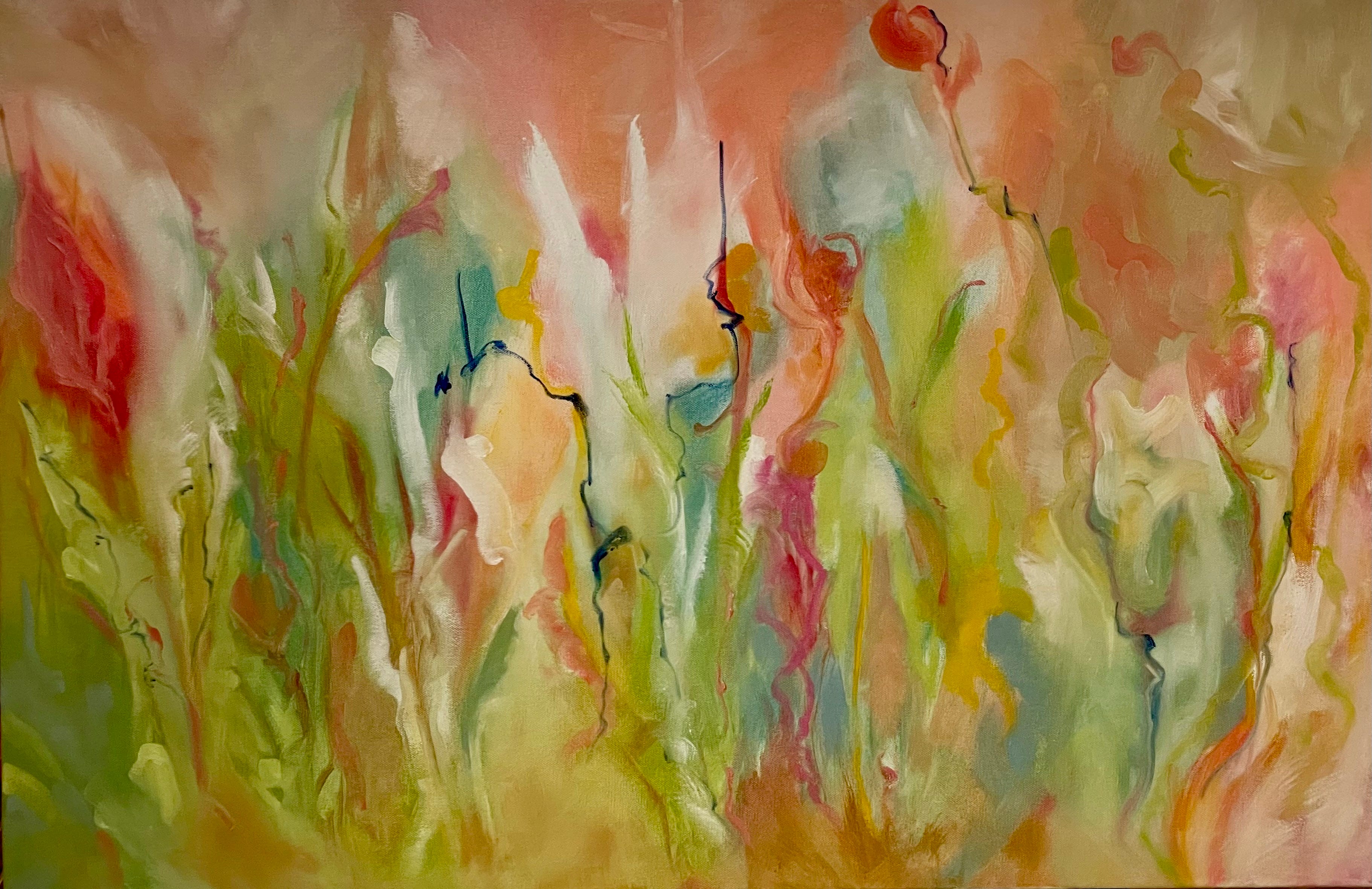
So what is generosity in art? I am just beginning this exploration, but I think it is letting desire speak plainly. That sounds like a funny thing to say, but, at least in my case, it can be difficult to simply express beauty. So many things lie between myself and my notion of beauty! When I make art, I seem to feel the need for a struggle. It is a struggle. I don’t see clearly what I want to say, especially with abstracts, a form of painting that I find to be the most difficult because there are the fewest guidelines for the imagery. (Landscapes, in contrast, are the easiest for me because I have the horizon.)
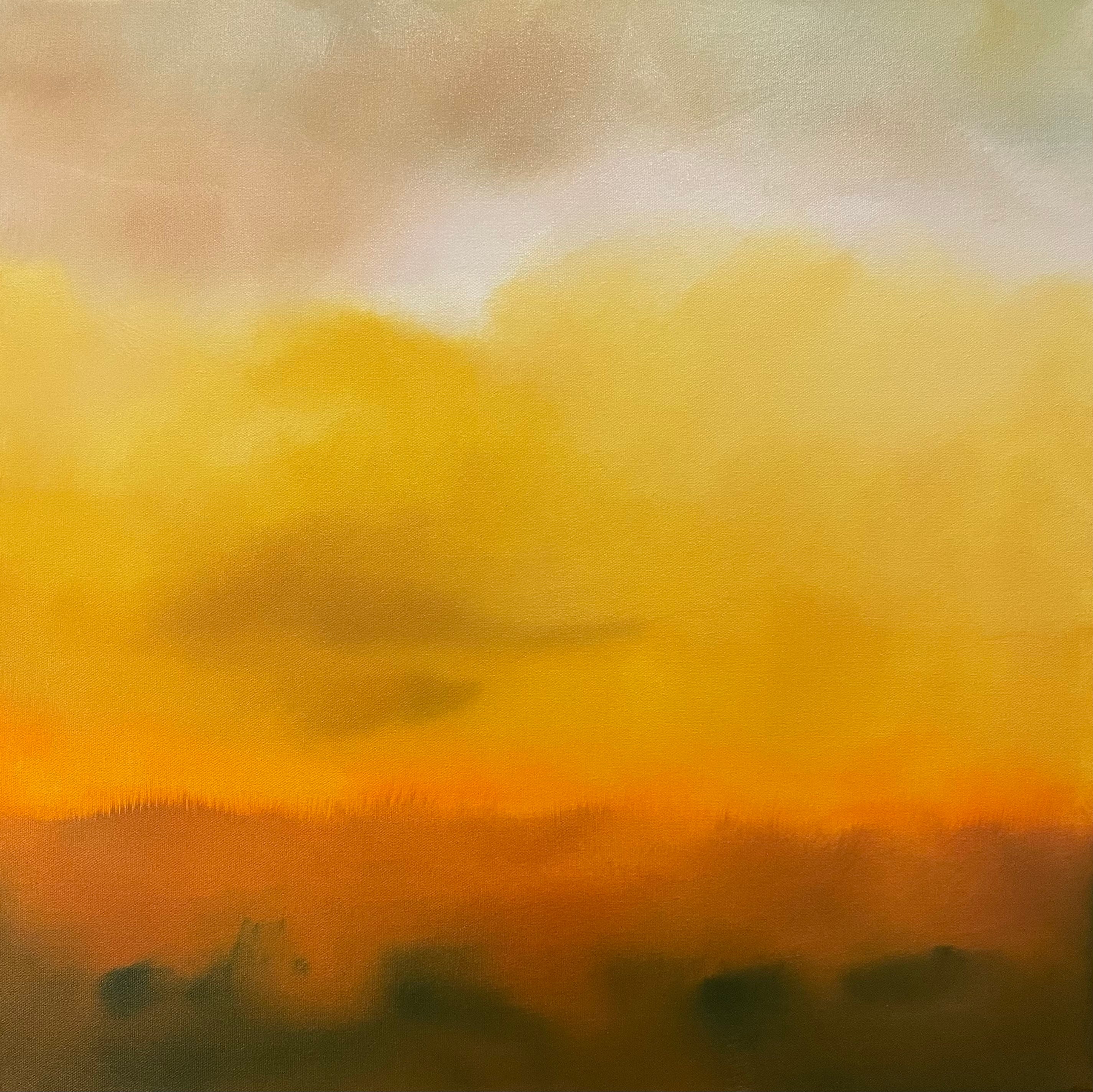
The first painting I am sharing, the yellow landscape, came easily. I almost painted over it because it was so easy. I am accustomed to struggle. It is almost as if in my narrative of painting there needs to be a fight in order for the painting to succeed. When it is easy, it is often because I feel at peace, and yet I wonder if I have left the narrative of the painting.
It is not easy to feel joy. Joy is is easy, but it is not easy to be there. It means leaving the story of hardship; the story of being human. A strange attachment. I ask myself if I can surrender to generosity, if I can leave the story behind.
Namaste
Love the generosity concept. It’s as beautiful as your art is.